
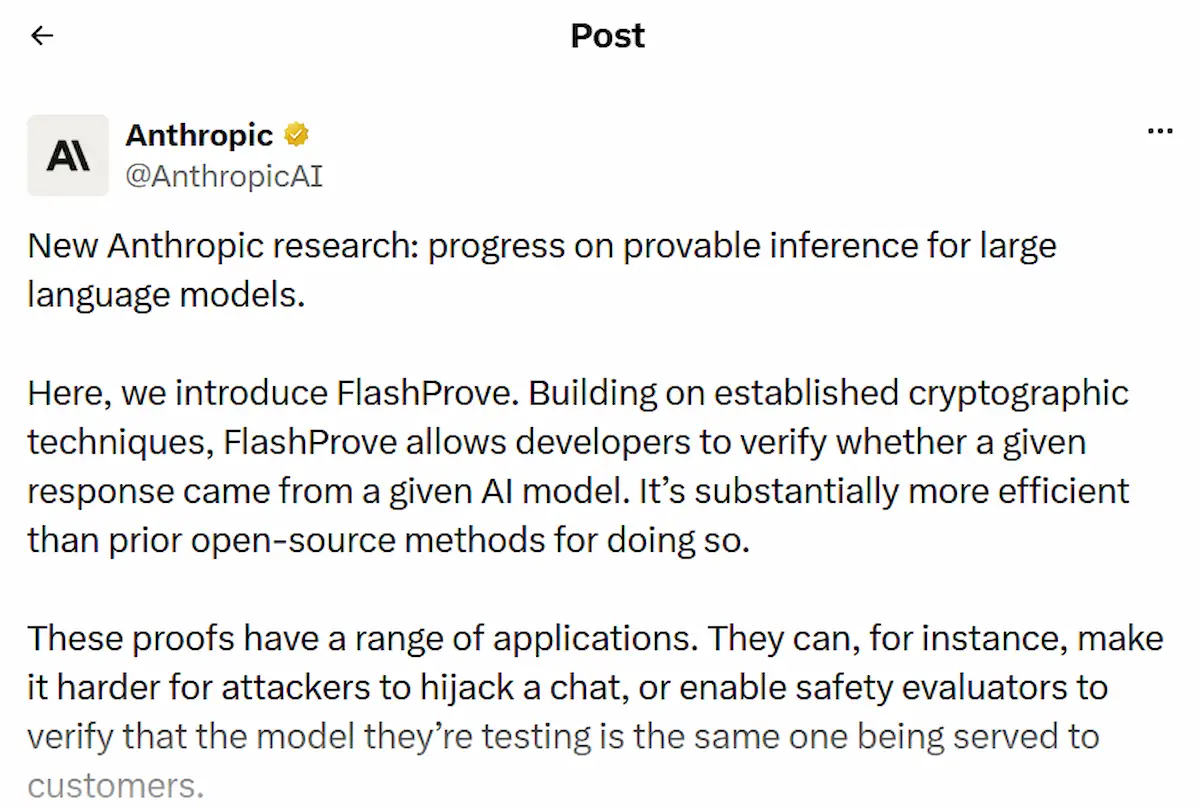
Verifying the origin of generated tokens has become a crucial infrastructure requirement, and Anthropic FlashProve effectively addresses this vulnerability in enterprise pipelines. By attaching cryptographic digital signatures to each response payload, this system enables
engineers to confidently authenticate that an output comes from a legitimate Claude model. This verification helps prevent middlebox tampering and ensures that high-stakes automated decisions are supported by valid AI architecture. This framework requires adjustments to latency budgets and gateway validation layers.
Cryptographic authentication adds some overhead, but it’s manageable for your data ingestion cycles.
Truth 1: The Cryptographic Backbone
Anthropic FlashProve relies on a robust public key infrastructure (PKI) to guarantee response authenticity. Whenever an enterprise API request is processed, the model generates the text and signs the payload using a heavily secured private key. This prevents unauthorized interceptors from modifying the text in transit.
Your local API gateway or application server then uses Anthropic’s public key to mathematically verify the signature before passing the data to your internal databases. If a single character in the payload has been altered by a man-in-the-middle attack, the cryptographic hash will fail.
This level of security mirrors the NIST cryptographic standards used in financial transaction processing. It upgrades LLM interactions from standard HTTP exchanges to zero-trust, verifiable data streams.
Truth 2: Latency vs Verification Trade-offs
Introducing cryptographic validation into a high-speed AI pipeline inevitably impacts system latency. Your servers must spend compute cycles hashing the incoming Anthropic FlashProve payload and verifying the signature against the public key.
For asynchronous tasks like batch document processing, this millisecond delay is entirely negligible. However, for real-time customer service agents operating on voice protocols, engineers must carefully optimize their validation scripts to prevent noticeable lag.
Caching the public keys locally in memory, rather than fetching them for every request, is mandatory for maintaining high-throughput performance while enforcing strict origin validation.
| Authentication Method | Spoofing Risk | Processing Latency | Best Use Case |
|---|---|---|---|
| Standard API Key | High (Middlebox interception) | Near Zero | Low-risk internal testing |
| Anthropic FlashProve | Near Zero (Cryptographic) | 10ms – 50ms overhead | Enterprise financial/medical data |
| Mutual TLS (mTLS) | Low | High setup overhead | Strict server-to-server networks |
Truth 3: Mitigating Middlebox Attacks
A major vulnerability in standard API deployments is the risk of middlebox spoofing. In these scenarios, a compromised proxy server intercepts the request and returns a cheap, hallucinated response from a lesser model while mimicking the primary provider’s headers.
Anthropic FlashProve renders this attack vector mathematically impossible. Because the interceptor does not possess Anthropic’s private key, any forged response they generate will instantly fail the public key validation check on your receiving server.
This guarantees that if your application pays for Claude 3.5 Opus logic, you are definitively receiving and executing Claude 3.5 Opus logic, protecting your operational integrity.
Truth 4: Implementing Signature Validation
To leverage Anthropic FlashProve, your development team must update your ingestion webhooks to parse and validate the new cryptographic headers. Relying solely on a 200 OK HTTP status is no longer sufficient for secure environments.
The validation logic should sit at the absolute edge of your network, dropping invalid payloads before they ever reach your core application logic. This prevents malicious prompts or spoofed data from triggering backend workflows.
Here is a conceptual Python example demonstrating how an edge gateway might validate an incoming signature using the Python Cryptography library before processing the text:
from cryptography.exceptions import InvalidSignature
from cryptography.hazmat.primitives.asymmetric import padding
from cryptography.hazmat.primitives import hashes

def verify_flashprove_payload(public_key, payload_bytes, signature):
    try:
        # Validate the cryptographic signature of the LLM output
        public_key.verify(
            signature,
            payload_bytes,
            padding.PKCS1v15(),
            hashes.SHA256()
        )
        return True
    except InvalidSignature:
        # Drop the payload immediately if tampering is detected
        print("CRITICAL: Model spoofing detected. Payload rejected.")
        return False
Truth 5: Compliance in Regulated Sectors
In sectors such as healthcare, defense, and finance, the implementation of generative AI has faced challenges due to strict audit requirements. Regulators require clear evidence of the origin of decisions and the systems that generated the data.
Anthropic FlashProve offers a verifiable audit trail that meets these compliance needs. By recording digital signatures alongside model outputs, organizations can mathematically demonstrate that an approved AI model produced a specific document.
This feature aligns perfectly with the data provenance requirements expected in upcoming legislation, helping to remove significant regulatory barriers for enterprise adoption.
Truth 6: The Future of API Routing
As multi-agent orchestration becomes the standard, requests will frequently bounce between different models based on complexity and cost. Managing this routing securely requires standardized model identity.
With frameworks like Anthropic FlashProve, dynamic routers can securely verify the origin of a sub-task before passing it to the next agent in the chain. This prevents a compromised secondary agent from injecting malicious data into the primary workflow.
Standardized cryptographic identity will eventually become the baseline expectation for all tier-one LLM providers, ensuring interoperability and security across hybrid AI networks.
Truth 7: Updating Your Enterprise Gateway
Upgrading your infrastructure to support verifiable model outputs requires an audit of your current API gateways and automation platforms like n8n or Make.com. You must ensure your HTTP nodes can capture and process cryptographic headers.
Begin by mapping exactly where model outputs trigger automated database writes. These specific junctions are where Anthropic FlashProve validation must be implemented first, as they represent your highest risk of data contamination.
For an overview of the initial rollout and broader industry context, review the coverage on TechCrunch. Securing your pipeline today prevents catastrophic data spoofing tomorrow.
Ready to lock down your workflow costs and secure your API? Grab the framework.