
The reality of building automated AI pipelines is that inefficient data structures will destroy your operational budget before you ever reach scale. Implementing a strict token optimization framework is essential because every API request sent to models like OpenAI or Anthropic bills you for input and output tokens. A bloated JSON payload directly translates to wasted capital. By prioritizing token optimization, you can drastically reduce latency and operational overhead. This guide breaks down the architectural tactics required to lean out your workflows and maximize your API budget.
Strategy 1: Isolate Core Content for Better Token Optimization
Raw data feeds are packed with expensive garbage. When you pull from an RSS feed or a standard webhook, you inherit tracking scripts, inline CSS, and excessive HTML attributes. Pushing this raw data into an LLM wastes thousands of tokens on context the model doesn’t need.
You must programmatically strip the payload before the API request is constructed. Use Regex or HTML parsing nodes to extract only the absolute necessities: the title, the core text body, and relevant timestamps. This single step often cuts input token volume by over 60%.
The goal is high data density. The model should only process the exact information required to generate the target output, minimizing processing time and direct token costs.
Strategy 2: Enforce Strict JSON Schemas
Unstructured data invites errors and forces the LLM to waste tokens guessing your intent. If your prompt asks the model to return data in a specific format without providing a strict schema, you risk receiving bloated, conversational outputs.
Leverage structured outputs or JSON mode, and explicitly define the expected key-value pairs in your system prompt. For example, if you need a summary, mandate a schema that restricts the output to a single string value.
{
  "type": "object",
  "properties": {
    "summary": { "type": "string" }
  },
  "required": ["summary"],
  "additionalProperties": false
}Strategy 3: Deploy Limit Nodes and Throttling
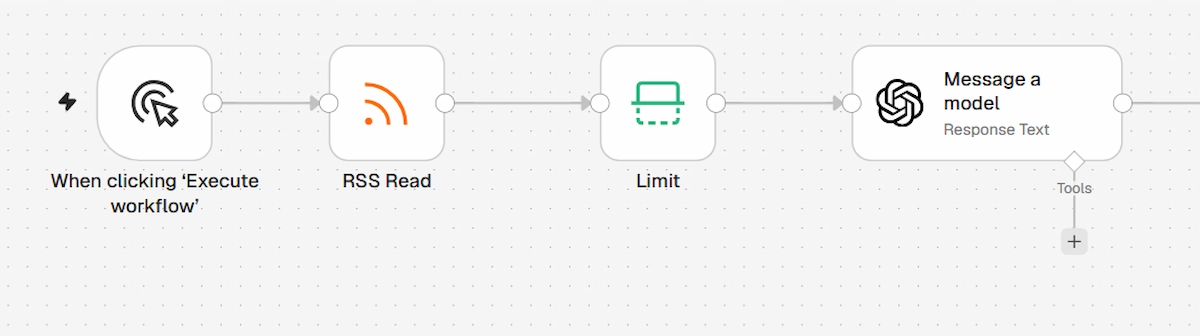
Uncontrolled ingestion cycles are the silent killers of API credits. If an RSS reader triggers every 5 minutes and processes the entire feed instead of just new items, you are paying to process the same data repeatedly.
Implement strict rate-limiting and item-limiting nodes at the start of your workflow. During testing phases, throttle your pipeline to process exactly ONE item per execution.
This prevents runaway loops from draining your account balance while you are fine-tuning your prompts and payload structures. Control the flow of data before it reaches the expensive processing layer.
Strategy 4: Implement Intelligent Caching Layers
Not every query requires a fresh LLM generation. If you are processing standardized data or frequently asked questions, querying the API every time is highly inefficient.
Build a caching layer using Redis, a lightweight database, or even a localized JSON file to store the results of expensive API calls. Before sending a request to the LLM, check the cache for an existing response based on a hash of the input data.
This approach drastically reduces API volume for static or slowly changing content, ensuring your token optimization efforts are maximized and you only pay for computation when genuinely new information is introduced.
| Optimization Layer | Implementation Method | Estimated Token Reduction |
|---|---|---|
| Payload Stripping | Regex / HTML Parser Nodes | 40% – 60% |
| Schema Enforcement | JSON Strict Mode | 15% – 25% |
| Prompt Trimming | Declarative System Instructions | 10% – 15% |
| Caching (Static Data) | Redis / Local DB Lookup | Up to 100% per hit |
Strategy 5: Optimize System Prompts for Brevity
System prompts are appended to every single API request, meaning verbose instructions act as a recurring tax. Avoid conversational padding like “Please act as an expert and help me with…”
Use direct, declarative instructions. State the required role, the exact task, and the output constraints in as few words as possible. Review the OpenAI Prompt Engineering guide for best practices on concise instruction design.
Every word removed from your baseline system prompt saves you money across thousands of pipeline executions, making prompt brevity a core pillar of token optimization.
Strategy 6: Monitor and Audit Token Consumption
You cannot optimize what you do not measure. Failing to track token consumption per workflow execution leaves you blind to efficiency leaks and sudden cost spikes.
Log the token usage data returned in the API response headers for every successful request. Pipe this data into a monitoring dashboard or a simple spreadsheet to track trends over time.
Regularly audit this data to identify which specific workflows or data sources are consuming the most tokens. Explore tools on GitHub to find open-source token counting libraries that match your tech stack.
Strategy 7: Fallback Protocols for Token Optimization
API endpoints fail, and rate limits are hit. If your workflow doesn’t handle these events gracefully, it will either crash or enter a costly retry loop. Familiarize yourself with the Anthropic API limits or your chosen provider’s constraints.
Implement exponential backoff strategies for failed requests to avoid hammering the endpoint and incurring penalty blocks.
Design your system to degrade gracefully. If the primary LLM is unavailable or too expensive during peak times, route the request to a smaller, cheaper model to maintain pipeline momentum. Mastering token optimization ensures your AI architecture remains scalable, predictable, and highly cost-effective.
Ready to lock down your workflow costs? Grab the framework.