
The most useful ai agent use cases are the ones that solve real problems instead of creating more complexity. AI agents are especially valuable when a task has multiple steps, needs context, and would normally take a lot of manual work.
In this post, we will explore the best ai agent use cases for business, productivity, research, support, and automation. If you are wondering where to start, this guide will help you identify the most practical opportunities.
The Quick Answer
Here is the simplest explanation of ai agent use cases: they work best when a task is too complex for a chatbot and too flexible for basic automation. If a workflow needs planning, tool use, or multiple actions, an AI agent may be a strong fit.
That is why many teams are now exploring ai agent use cases in customer service, sales, operations, content, and research.
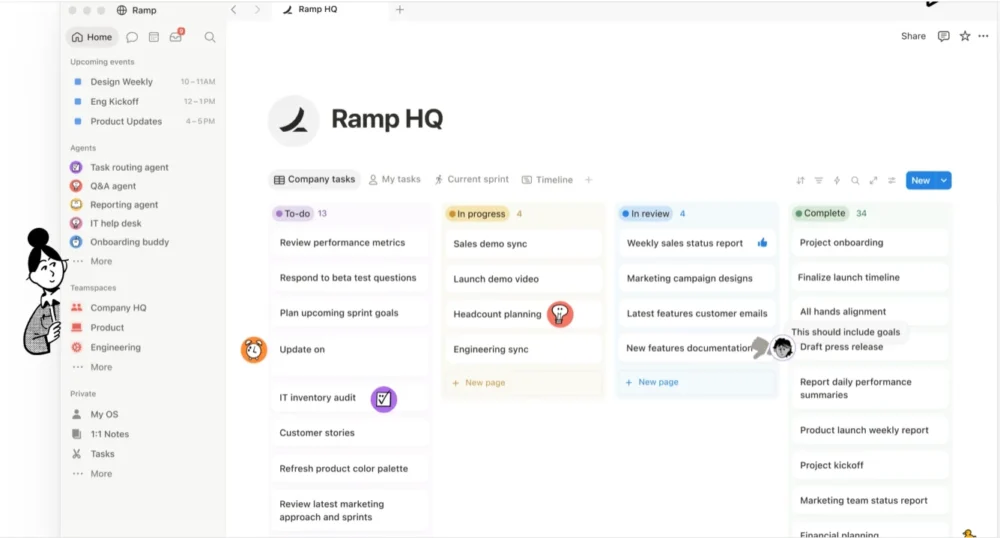
Below is an example of ai agent tasks by notion.com
What Are AI Agent Use Cases?
AI agent use cases are real-world situations where an agent helps complete a task by understanding a goal, using tools, checking results, and continuing until the workflow is done. These use cases go beyond basic Q&A.
When people search for ai agent use cases, they usually want practical examples they can apply immediately. The good news is that there are many, and most of them do not require advanced technical setups to start.
If you want the foundation first, read: How AI Agents Work.
Business Use Cases
Business is one of the best areas for ai agent use cases because many tasks are repetitive, multi-step, and time-consuming.
1. Lead qualification
An AI agent can review incoming leads, gather background details, score interest, and send qualified prospects to the sales team.
2. Sales prep
The agent can research a company, summarize recent activity, and create talking points before a sales call.
3. Internal operations
An AI agent can help with task routing, status updates, and document handling across internal workflows.
These ai agent use cases can reduce admin time and help teams move faster without losing visibility.
Productivity Use Cases
Another major category of ai agent use cases is personal and team productivity.
4. Task planning
An AI agent can break a large goal into smaller steps and create a simple action plan.
5. Calendar management
It can suggest available meeting times, organize schedules, and help coordinate calendars.
6. File and note organization
An AI agent can help sort notes, tag files, and organize documents based on topic or project.
7. Email assistance
It can prioritize messages, draft replies, and flag items that need quick attention.
These ai agent use cases are ideal for users who want to spend less time on repetitive admin work.
Research Use Cases
Research is another strong fit for ai agent use cases because agents can gather, compare, and summarize information from multiple sources.
8. Market research
An AI agent can collect product details, summarize trends, and organize findings into a usable report.
9. Competitor research
It can compare competitors, pull out positioning differences, and highlight strengths or weaknesses.
10. Document summarization
The agent can read long documents and turn them into concise summaries, saving significant time.
This is especially useful for creators, analysts, marketers, and founders who need speed without losing context.
Customer Support Use Cases
Customer support is one of the most practical areas for ai agent use cases because it combines communication, classification, and follow-up tasks.
11. Ticket routing
The agent can identify the topic of a support request and send it to the right queue or team.
12. Response drafting
It can draft helpful first responses for common questions, saving support teams time.
13. Escalation handling
If a request is urgent or sensitive, the agent can flag it for human review instead of handling it automatically.
These ai agent use cases are useful because they speed up service while keeping humans in the loop for complex situations.
More High-Value Use Cases
There are several other ai agent use cases worth watching:
- Content planning: help build outlines, topic ideas, and draft structures.
- Data cleanup: organize messy records or standardize entries.
- Meeting preparation: summarize notes and create action items before calls.
- Workflow follow-up: remind teams about tasks and next steps.
- Client onboarding: guide users through setup, forms, and first steps.
These use cases are especially valuable when the current process involves too many manual touches.
Best Practices Before You Start
Before choosing among different ai agent use cases, start with one clear problem and define the outcome you want.
- Choose one workflow that is easy to measure.
- Keep the first version simple.
- Add guardrails and approval steps where needed.
- Test the workflow on a small scale first.
- Review the cost, speed, and quality before expanding.
You can also compare this approach with other AI systems here: AI Agents vs Chatbots vs Automation.
How to Pick the Right Use Case
Not every workflow needs an AI agent. The best ai agent use cases usually have these traits:
- They involve multiple steps.
- They change often.
- They need tool use or external data.
- They benefit from speed and consistency.
- They still need human oversight in some situations.
If a task is stable and rule-based, automation may be better. If the task is mostly conversation, a chatbot may be enough. But if the task needs reasoning and action, AI agents may be the right fit.
Frequently Asked Questions
What are the best ai agent use cases for beginners?
Good beginner ai agent use cases include email sorting, meeting summaries, simple research, and task planning.
Do AI agent use cases require coding?
Not always. Many AI agent use cases can be built using no-code or low-code platforms.
Are AI agents useful for small businesses?
Yes. Small businesses can use AI agents for support, sales prep, content organization, and internal workflow help.
Should AI agents replace automation?
No. Automation is still excellent for repeatable tasks. AI agents are better for flexible, multi-step work.
How do I know if a use case is worth it?
If the workflow saves time, reduces manual effort, and can be tested safely, it may be a strong candidate.
Further Reading
From our blog:
- How AI Agents Work
- 7 Powerful AI Agent Examples
- AI Agents Explained: The Complete Guide
- AI Tools category
- AI Automation category
External resources:
Final Thoughts
The best ai agent use cases are practical, measurable, and easy to test. Start with one clear workflow, use a simple setup, and expand only after you see real value.
When applied well, AI agents can save time, improve consistency, and help teams focus on higher-value work instead of repetitive tasks.
Want your tool or brand featured in this series? Sponsor opportunities are available. Contact us through the site.