Today news post will be about Google latest release: Harness2.
If you are building autonomous systems in 2026, the cost of constantly fine-tuning massive language models is becoming unsustainable. To solve this, Google Cloud AI Research has officially open-sourced Google Harness2, a recursive agent harnessing framework that promises a massive upgrade in performance without ever touching the model’s core weights.
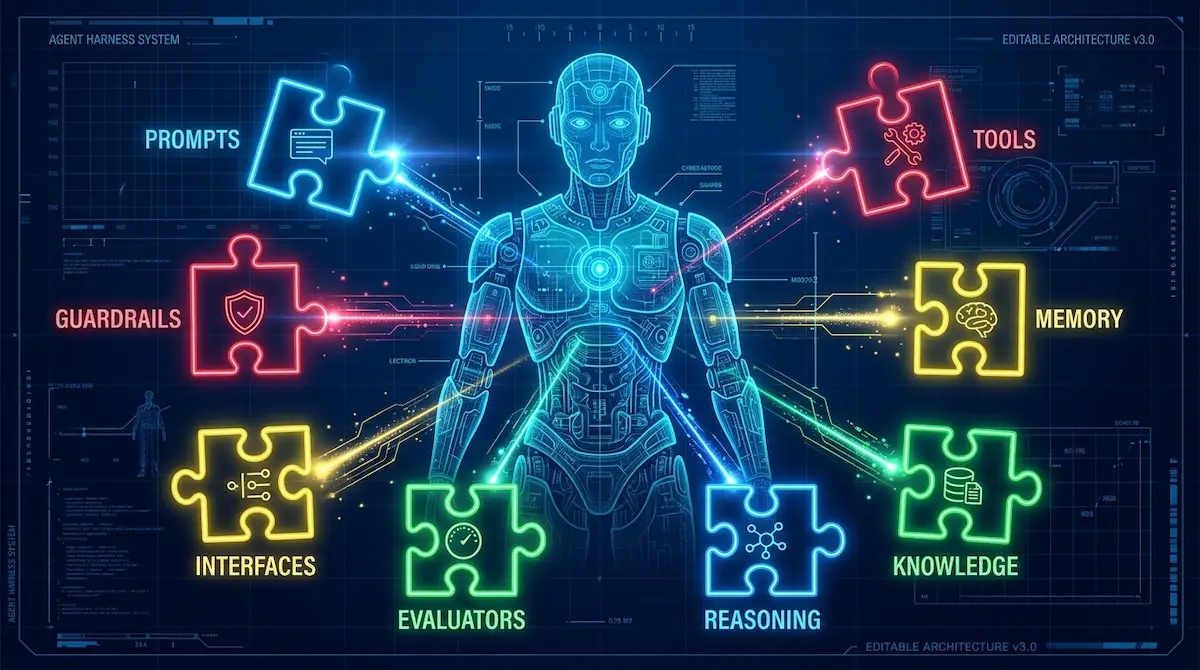
The pitch to developers is straightforward: your AI agent can get significantly smarter without needing a better, more expensive underlying model. By optimizing the “harness” the prompts, tools, memory, and orchestration wrapping the AI Google Harness2 fundamentally changes how we deploy open-world agents.
Here is exactly how this new framework operates and why it is outperforming traditional fine-tuning methods.
1. What Exactly is Google Harness2?
In AI development, a “harness” is everything surrounding the actual intelligence model. While a model (like Gemini 3.5 Flash or GLM-5) processes the data, the harness dictates how it interacts with the outside world.
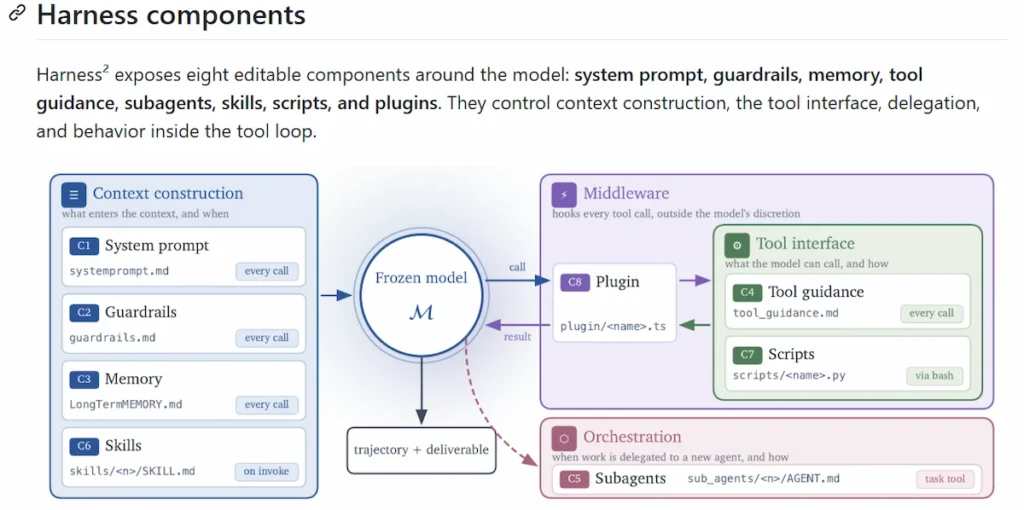
Google Harness2 is an Apache 2.0 licensed, plug-and-play framework designed to refine this system during live deployment. Instead of waiting for a developer to manually rewrite a system prompt or adjust an API connection, Google Harness2 uses recursive logic to evaluate its own performance and rewrite its 8 editable components on the fly.
These 8 components include crucial elements like System Prompts, Guardrails, Memory, Tool Guidance, and Plugins (middleware). By allowing the agent to dynamically alter these files, the AI can adapt to unseen tasks without human intervention.
Key Takeaway: The revolutionary aspect of Google Harness2 is that it learns across tasks by storing lessons in a dedicated EXPERIENCE.md library, allowing it to apply past solutions to completely new environments without needing a labeled training dataset.
2. The Power of Recursive Agent Harnessing
How does the AI actually improve itself? It uses a dual-level recursive loop:
- Task-Level Recursion (Propose, Probe, Compose): When given a new task, the framework proposes two new candidate harnesses. One targets general agent failures (like poor tool use), and the other targets domain-specific knowledge. It runs the task, compares the results against a baseline, and only keeps the edits that actually improved the behavior.
- Harnessing-Level Recursion: After the task is completed, a “reflector” analyzes what worked, saves the successful configuration, and updates the shared lesson library for the next task.
Before diving into deployment, review the benchmark impact data below to see how Harness2 significantly upgrades performance without updating weights:
| AI Model & Executor | WorkBuddy-Bench Score | JobBench Score | Net Performance Gain |
|---|---|---|---|
| Gemini 3.5 Flash (OpenCode) | 72.4 → 77.5 | 31.5 → 36.0 | +5.1 pts (WorkBuddy) |
| Gemini 3.5 Flash (Codex) | 74.5 → 77.5 | 33.9 → 35.3 | +3.0 pts (WorkBuddy) |
| GLM-5 (OpenCode) | 64.2 → 75.7 | 20.6 → 24.2 | +11.5 pts (WorkBuddy) |
| GLM-5 (Codex) | 64.4 → 75.3 | 23.6 → 24.8 | +10.9 pts (WorkBuddy) |
Key Takeaway: As shown in the data above, weaker models benefit the most. After just one recursive step under the Google Harness2 framework, the GLM-5 model gained a massive 11.5 points on the WorkBuddy-Bench, allowing it to beat the base performance of the much larger Gemini 3.5 Flash.
3. How to Deploy the Framework Today
For developers looking to integrate this into their stack, the requirements are relatively lightweight. The framework runs on Linux using Python 3.12 or 3.13.
To run a local demo without needing model credentials, you can set up a virtual environment and use the uv package manager:
uv venv --python 3.12
source .venv/bin/activate
uv pip install -e '.[render]' harness2-demo --output runs/demo --k 2
For full model-backed runs, you will need Node.js 20+, the Google Cloud CLI, and an active Vertex AI project.
Pro Hint: Sandbox Your Agents
While Google Harness2 is incredibly powerful, allowing an agent to dynamically rewrite its own middleware and tool-use scripts carries inherent security risks. Always run recursive agents in isolated Docker containers to prevent rogue tool usage from affecting your host machine or production databases.
External Resources & Technical Documentation:
- Read the full technical breakdown at MarkTechPost.
- Review Google’s official cloud deployment rules at Vertex AI Documentation.
Explore More on The NexGen AI:
- Compare autonomous coding platforms in our Cursor vs GitHub Copilot Guide.
- Learn how to structure prompts for agents using our Perfect AI Prompt RTC Framework.
- Stay updated on the latest model releases in our Enterprise AI & News Hub.