
This is the last post in the AI agents ai agents for students can do more than answer questions — they can help plan study time, organize notes, build quizzes, summarize research, and guide learning step by step. Used well, they act like a study assistant that works between classes, not just during homework time. This guide shows you how to use AI agents for students the smart way, with real examples and practical prompts.
The Quick Answer
ai agents for students work best when they handle repeated learning tasks: organizing notes, creating revision plans, generating practice questions, and helping you review weak spots. The goal is not to let the agent do your schoolwork for you — it is to make studying faster, more structured, and more effective.
What AI Agents for Students Actually Do
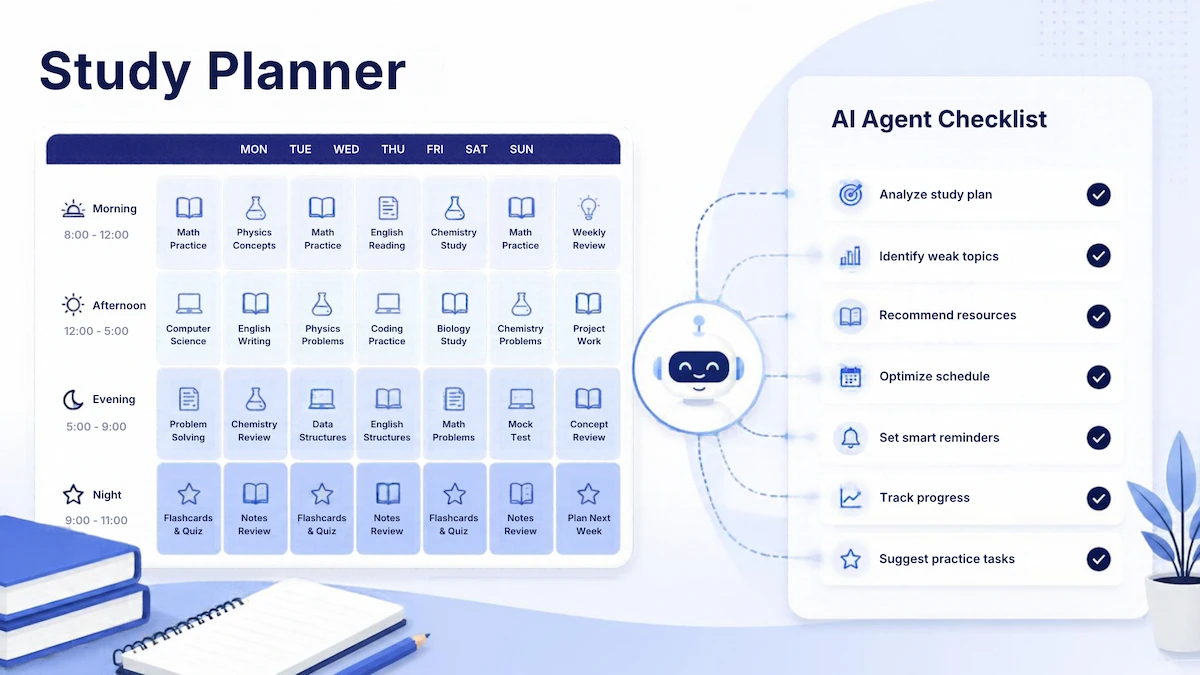
Unlike a basic chatbot, ai agents for students can follow a workflow. That means they can take a goal like “help me revise for biology” and break it into smaller steps such as collecting topics, making a revision schedule, generating quizzes, and tracking what you still need to review.
That is the big difference: a chatbot answers one question, while ai agents for students can help manage an entire learning process. That makes them much more useful for busy students who need more than one-off answers.
9 Best Uses of AI Agents for Students
1) Build a weekly study plan automatically
ai agents for students can turn deadlines, exam dates, and available study hours into a realistic plan. Instead of guessing what to study first, the agent can prioritize weak subjects and spread revision across the week.
2) Organize class notes into clean summaries
If your notes are messy, an agent can group them by topic, remove repetition, and turn them into cleaner revision material. This is one of the most useful ways ai agents for students save time.
3) Create practice quizzes from your study material
One of the best uses of ai agents for students is turning notes into quizzes. The agent can ask multiple-choice questions, short-answer questions, or flashcard-style prompts so you can test yourself instead of passively rereading.
4) Help you research a topic step by step
If you have a project or essay, the agent can suggest search terms, organize sources, and help structure your research process. That is much more useful than starting from a blank page.
5) Turn a broad assignment into a clear outline
Students often struggle not because the assignment is hard, but because the instructions are vague. ai agents for students can help break a broad prompt into sections, claims, evidence, and a final structure.
6) Give step-by-step help with math, coding, and problem solving
Instead of giving the final answer immediately, a well-designed agent can give hints, ask guiding questions, and move you forward one step at a time. That makes ai agents for students more like tutors than answer keys.
7) Improve writing without replacing your voice
You can ask an agent to review grammar, structure, tone, and clarity. The best ai agents for students do not rewrite everything from scratch — they help you improve what you already wrote.
8) Prepare for presentations and interviews
Ask the agent to act like a teacher, panel, or interviewer. It can challenge your answers, ask follow-up questions, and help you rehearse until you feel more confident.
9) Track progress and spot weak areas
Some ai agents for students can keep track of what you have already studied and what still needs revision. That makes it easier to focus on the topics that actually need work instead of wasting time on what you already know.
Real-World Student Examples
Example 1: Exam revision : A student preparing for three exams used ai agents for students to create a 7-day revision plan. The agent separated topics by priority and created a short quiz for each day, which made revision feel less chaotic.
Example 2: Essay planning : A student had a research assignment with a vague topic. The agent helped turn it into a narrower question, suggested section headings, and made the writing process much easier to manage.
Example 3: Coding practice :A beginner learner got stuck on a Python assignment. Instead of giving the full answer, the agent gave hints, checked the logic, and helped the student fix errors one step at a time.
Example 4: Language learning: A student used an agent to simulate a simple conversation in English. The agent corrected grammar, explained mistakes, and repeated the exercise until the student became more confident.
Prompt Examples You Can Copy
1) Build me a 7-day study plan:
- Subject: [subject]
- Exam date: [date]
- Hours available per day: [hours]
- Weak topics: [list]

2) Turn these notes into a quiz:
[Paste notes]
- Ask one question at a time
- Mix multiple choice and short answers
- Wait for my answer before showing the solution

3) Organize my assignment:
[Paste assignment prompt]
Help me create:
- a clear topic
- 3 main sections
- 5 supporting points per section

4) Help me with this coding task:
[Paste problem]
Do not give the full solution first.
Give me step-by-step hints and let me try each step.

5) Review my paragraph:
[Paste text]
Check for:
- clarity
- grammar
- weak transitions
- missing evidence
Pro Hints for Better Results
- Give the agent context: your grade, subject, deadline, and goal.
- Use one task per request: the more focused the prompt, the better the result.
- Ask for hints first: especially for math, science, and coding.
- Make it quiz you: active recall is where real learning happens.
- Always verify important facts: names, dates, and citations should be checked before submission.
Safety and Honesty Checklist
Use ai agents for students responsibly. They should support learning, not replace it. Before using any AI tool for schoolwork, check your school or university rules and avoid sharing private information.
For a broader education perspective, see UNESCO’s AI in education resources.
- Do not paste passwords, IDs, or private documents.
- Do not submit AI output as your own work if your school forbids it.
- Check facts against trusted sources or your course materials.
- Use AI for planning, feedback, and practice not cheating.
Simple rule to remember
If the agent is doing the thinking for you, you are using it wrong. If it is helping you think better, ai agents for students is doing exactly what it should.
FAQ
Are AI agents for students just cheating tools?
No. Not when used properly. ai agents for students are best used for studying, planning, summarizing, and practice. The problem starts when students use them to bypass learning or submit work they did not create.
What is the best first use case?
Start with study planning or quiz generation. Those are simple, low-risk ways to see how ai agents for students can help before moving into more advanced workflows.
Can AI agents replace tutors?
Not completely. A tutor can still provide human judgment and accountability. But ai agents for students are excellent for practice, feedback, and structured study between sessions.
Final Thoughts
ai agents for students are best used as learning assistants, not answer machines. They can help you study smarter, organize your work, and practice more consistently but the real value comes when you stay actively involved in the learning process.
If you want to keep building with practical AI workflows, read our guides on AI agents vs chatbots vs automation and how AI agents work.