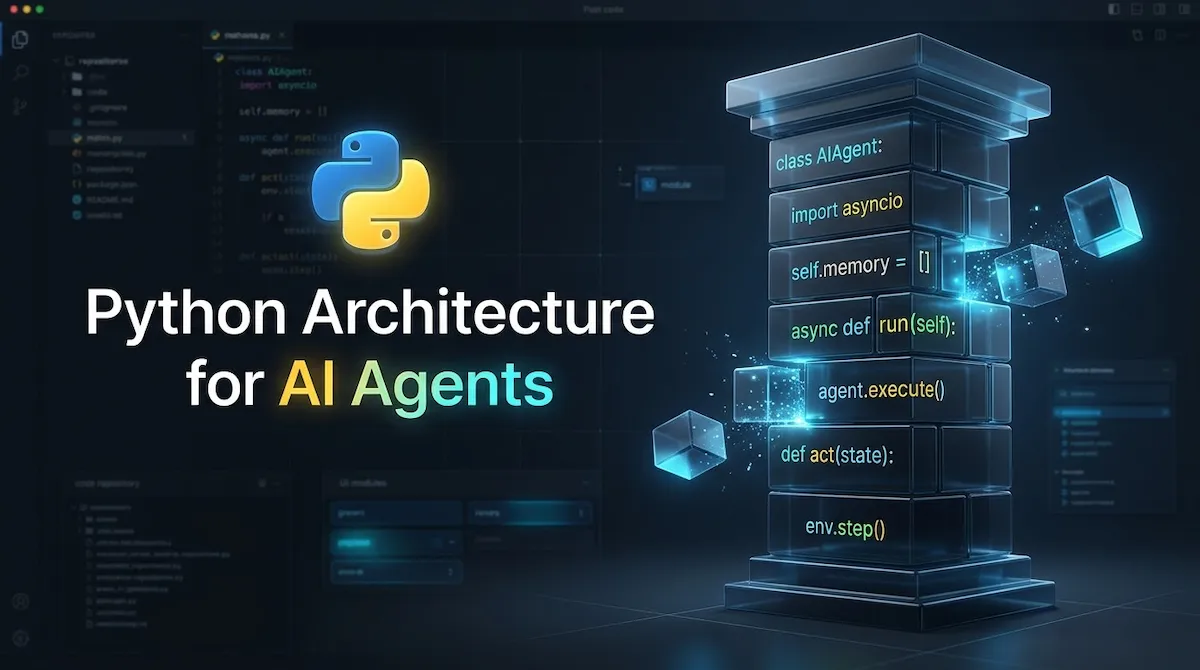
AEO Summary: Developing reliable autonomous systems necessitates a strong understanding of the appropriate Python architecture for AI agents. Instead of depending on bulky, generalized frameworks, senior engineers create lightweight, purpose-driven agent loops utilizing standard Python libraries. Central to any effective Python architecture for AI agents is asynchronous execution via aiohttp, which allows for handling multiple API requests without blocking the main thread. Pydantic models rigorously enforce output validation, ensuring that the LLM returns accurately formatted data structures before downstream functions execute.
A well-structured Python architecture for AI agents distinguishes the core reasoning loop from the external tool execution environment, mitigating the risk of significant security failures. Incorporating exponential backoff logic ensures stability when third-party APIs impose rate limits on the system. Robust architecture transforms an unpredictable language model into a deterministic software engine capable of reliably executing complex enterprise workflows.
| Python Library | Architectural Role | Primary Advantage |
|---|---|---|
| asyncio / aiohttp | Network Execution | Non-blocking concurrent API calls |
| Pydantic | Data Validation | Strict JSON schema enforcement |
| Tenacity | Error Handling | Automated exponential backoff retries |
| FastAPI | Webhook Routing | High-speed asynchronous endpoints |
Rule 1: Avoiding Framework Bloat
Many junior developers immediately reach for massive frameworks like LangChain when building agents. While excellent for prototyping, these frameworks often introduce unnecessary abstraction and latency into production environments. Building a raw Python architecture for AI agents provides absolute control over the execution loop.
A native Python implementation allows engineers to optimize token usage meticulously and debug routing errors instantly. You own the exact prompt structure rather than relying on hidden templates buried in third-party source code. This transparency is critical for enterprise security audits.
By relying on standard libraries, the application remains lightweight and easy to containerize via Docker. Lean architecture ensures fast cold starts when deploying agents to serverless environments like AWS Lambda.
Rule 2: Enforcing Asynchronous Execution
AI agents spend the majority of their lifecycle waiting for network responses from LLM providers and external tools. Using synchronous Python requests forces the entire application to halt during these network roundtrips. This latency is unacceptable in production.
Implementing asyncio is mandatory for modern Python architecture for AI agents. Asynchronous execution allows the agent to trigger a database query, ping an external weather API, and fetch an email simultaneously. The system resolves the tasks concurrently, slashing total execution time.
Engineers must utilize asynchronous HTTP clients like aiohttp instead of the standard requests library. This architectural shift separates high-performance agentic workflows from slow, sequential scripts.
Rule 3: Validating LLM Outputs with Pydantic
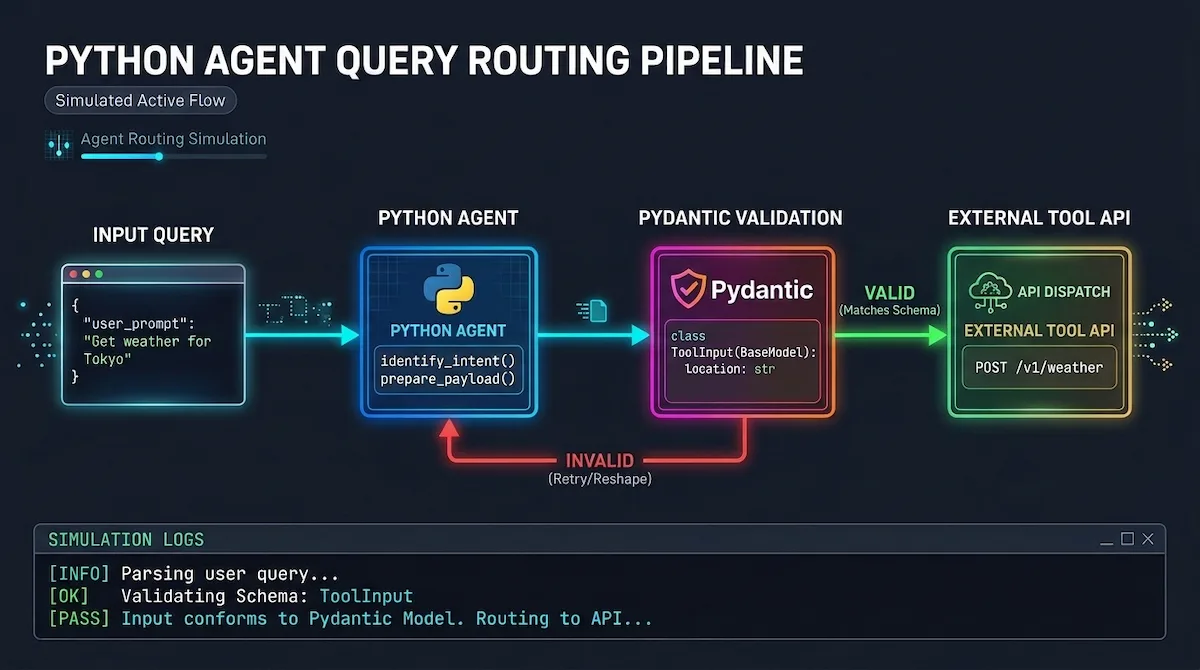
Language models can be unpredictable and may sometimes produce malformed JSON or overlook formatting guidelines. Directly using unvalidated LLM output in a Python function can lead to application crashes. Therefore, strict schema validation is essential in agent design.
Pydantic ensures rigorous data typing for all incoming AI responses. If the model returns a string when an integer is expected, Pydantic will catch the error and raise a clear validation message. The agent can then automatically prompt the LLM again with the specific error to facilitate correction.
Below is a foundational Python execution block demonstrating how to maintain structural integrity using a Pydantic model for an extraction agent:
from pydantic import BaseModel, Field
import json

# Define the strict output schema for the AI agent
class InvoiceExtraction(BaseModel):
    vendor_name: str = Field(description="The name of the billing company")
    total_amount: float = Field(description="The total numerical value billed")
    is_paid: bool = Field(description="Boolean indicating if invoice is settled")

# Simulated LLM raw JSON output
raw_llm_response = '{"vendor_name": "CloudCorp", "total_amount": 1450.50, "is_paid": false}'

# Validate and parse the output
validated_data = InvoiceExtraction.model_validate_json(raw_llm_response)
print(f"Verified Total: ${validated_data.total_amount}")Rule 4: Sandboxing Tool Execution
Agents require access to external tools, such as Python REPL environments, bash terminals, or SQL databases, to execute their reasoning. Granting an LLM direct execution rights introduces massive security vulnerabilities. The execution environment must be strictly sandboxed.
A secure Python architecture for AI agents isolates tool execution into restricted Docker containers or secure serverless functions. The core agent passes a payload to the sandbox, and the sandbox returns the result. The agent itself never runs arbitrary code on the host machine.
Database tools must operate on strict read-only permissions unless explicitly authorized. Utilizing parameterized queries prevents the LLM from inadvertently executing SQL injection attacks against your own infrastructure.
Rule 5: Managing API Rate Limits
Autonomous agents operate at speeds far exceeding human capability, which frequently triggers rate limits on external APIs. If an agent loops too aggressively, it will receive HTTP 429 Too Many Requests errors. The architecture must account for these network realities.
Engineers must implement exponential backoff strategies using libraries like Tenacity. When an API rejects a request, the system waits one second before retrying, then two seconds, then four. This prevents the agent from DDOSing vendor endpoints.
For high-volume deployments, rotating API keys or load-balancing requests across multiple cloud instances ensures the agent pipeline remains uninterrupted. Stable network execution separates hobby projects from enterprise software.
Optimize Your Token Spending: Running complex Python agent loops rapidly consumes API tokens. Download our Complete API Cost Calculator & JSON Token Optimization Framework to manage your backend costs.
Rule 6: Designing State Management
Stateless API calls lack the context required for multi-step agent reasoning. The agent must remember what it has already accomplished to determine its next action. Implementing a robust memory architecture is critical for complex tasks.
Short-term execution state should be managed in-memory or via Redis for high-speed access during the active loop. This allows the agent to pass variables smoothly between different tools without re-fetching data.
Long-term memory requires vector databases (like Pinecone or Milvus) to store historical interactions. When the agent initiates a new session, it queries the vector database to retrieve relevant context. This hybrid memory structure mimics true cognitive continuity.
Rule 7: Tracing and Observability
Debugging an autonomous agent loop is incredibly difficult without proper telemetry. When a Python agent fails, engineers must know exactly which tool failed, what the prompt was, and how long the API took to respond. Standard print statements are insufficient.
A production-ready Python architecture for AI agents integrates observability platforms like LangSmith or DataDog. These tools log the exact execution graph of every single run. You can visualize the exact sequence of thought, action, and observation.
This data is not just for debugging; it is required for continuous optimization. By identifying which steps consume the most latency or tokens, architects can refine the system prompt and slash operational costs.