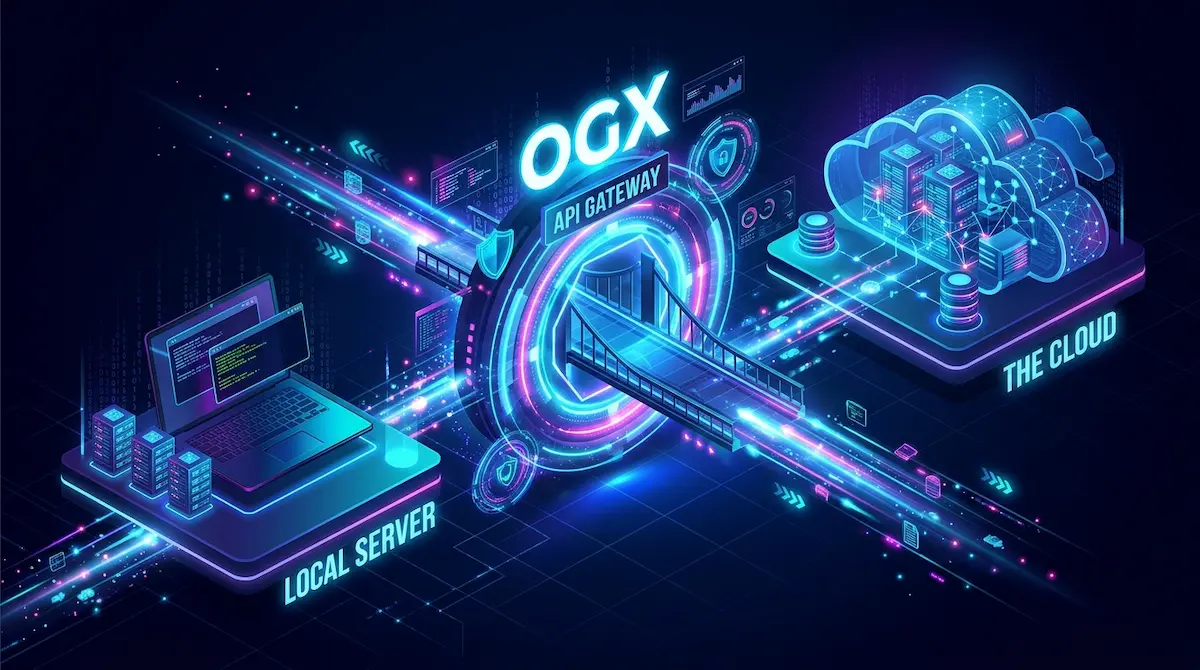
The OGX Agentic API server is officially changing how developers build offline artificial intelligence. If you have been researching local AI development recently, you have likely encountered a confusing overlap between Meta’s Llama Stack and a new project called OGX.
Here is the fact that resolves the confusion: OGX is the official rebrand of Meta’s Llama Stack. The name change signals a massive shift in their mission. It is no longer just a Llama-specific tool; it is now a model-agnostic, production-grade engine designed to run any AI model on any infrastructure.
For modern software developers, this server is a total game-changer. It acts as a drop-in, open-source replacement for the standard OpenAI API, allowing you to build complex, agent-driven software offline for zero cost.
Here are the 5 critical ways this architecture is revolutionizing open-source AI application development.
1. A Drop-In Replacement for OpenAI
The core pitch of the OGX Agentic API is its seamless compatibility. You do not need to learn a proprietary new coding language or SDK to use it. You simply boot up the server on your local laptop and point your existing OpenAI-compatible Python scripts toward it.
Here is how simple it is to route a standard OpenAI chat request to your local OGX server running an Ollama backend:
import httpx
from openai import OpenAI

# Connect to the local OGX server instead of OpenAI
client = OpenAI(
    base_url="https://localhost:8321/v1",
    api_key="fake", # API key is bypassed for local servers
    http_client=httpx.Client(verify=False),
)

response = client.responses.create(
    model="ollama/llama3.2:3b",
    input="What is the OGX Agentic API?",
)
print(response.output_text)Because it uses the exact same SDK, you can write your code today using a free, local model, and tomorrow deploy that exact same code to production using a cloud provider without rewriting your application architecture.
2. Server-Side RAG (Retrieval-Augmented Generation)
Historically, building a RAG application required manually chunking PDF documents, converting them into vector embeddings via a separate script, and wiring up a complex third-party vector database like Pinecone.
This server handles this entirely backend. By uploading a document directly to the API, the server automatically chunks, embeds, and indexes the file in three simple steps:
# 1. Upload a document to the OGX server
file = client.files.create(
    file=open("lease_agreement.pdf", "rb"),
    purpose="assistants",
)

# 2. Create a vector store automatically
vector_store = client.vector_stores.create(
    name="docbrain-kb",
    file_ids=[file.id],
)

# 3. Ask questions with automated file search
response = client.responses.create(
    model="ollama/llama3.2:3b",
    input="Summarize the key points of the lease",
    tools=[{
        "type": "file_search",
        "vector_store_ids": [vector_store.id],
    }],
)
print(response.output_text)When you ask a question, the server automatically searches the document to ground the model’s answer in absolute facts, rather than AI hallucinations.
OGX Agentic API : Review the architectural comparison below to see why developers are pivoting to this framework:
3. Executing True Agentic Tool Calling
Many AI wrappers claim to be “agentic,” but they only generate text that describes what you should do.
The OGX architecture allows you to register real Python functions as “tools.” If you ask the AI to review a lease agreement and flag any deadlines, it will not just summarize the dates in the chat window. If configured correctly, the server will autonomously trigger a custom tool to format those deadlines and physically save them to a JSON file on your computer’s hard drive. It actually does the bookkeeping for you.
4. MCP Server Integration and Privacy
The Model Context Protocol (MCP) is rapidly becoming the universal standard for connecting AI to external data. This system natively supports MCP server integrations. This means your locally hosted, zero-cost AI model can securely reach out and read your private Notion workspaces, GitHub repositories, or internal company Slack channels without exposing that sensitive corporate data to external tech corporations.
5. The Zero-Cost Production Pipeline
The ultimate reason software engineers are pivoting to this architecture is the deployment pipeline. You can build, test, and break your entire application locally using standard Python package managers.
Because the server intercepts all the API calls, the day your application goes viral and you need enterprise reliability, you simply swap the backend string to a managed cloud service. Your application logic, tool calling, and vector stores remain completely untouched.
External Resources:
- KDnuggets Technical Breakdown: Read the complete code tutorial for building an OGX document brain from scratch.
- Ollama Official Site: Download the infrastructure required to run local models smoothly behind your OGX server.
Explore More on The NexGen AI:
- Compare the top interfaces for local models in our Ollama vs LM Studio Breakdown.
- Learn how to use AI to write the Python code for these servers in our Vibe Coding Blueprint.
- Automate the data outputs of your AI agents with our Make.com vs Zapier Guide.