Understanding the machine learning fundamentals is a crucial first step for anyone aiming to build, scale, or optimize modern AI systems. At its core, machine learning empowers computers to identify patterns and make decisions based on data without explicit programming. This data-driven approach lets algorithms learn from historical examples and adapt to new, unseen situations, marking a significant departure from traditional, rule-based software. Mastering these machine learning fundamentals is vital for creating robust predictive models, automated workflows, and intelligent agency pipelines
Concept 1: The Core Mathematical Machinery
Before studying complex architectures, developers must understand the mathematical framework that allows algorithms to parse data. Features (individual measurable properties of a dataset) are the raw inputs, while labels represent the target outcomes. Machine learning uses historical training datasets to map relationships between these features and labels, generating models that predict future behavior.
The goal is generalization, ensuring the model performs well on new, unseen data rather than just memorizing its training examples. If a model is overfit, it has memorized the training noise and will fail to deliver value in production. This core machine learning fundamentals challenge requires continuous tuning and algorithmic regularization.
These mathematical mappings are what enable enterprise applications to adapt to new patterns over time. Unlike deterministic logic, a model learns from data features to predict outcomes like transaction fraud, customer churn, or hardware system failure with high probability.
Concept 2: Supervised Learning Foundations
The most common machine learning fundamental approach in predictive modeling is supervised learning, which uses labeled datasets where both features and correct outcomes are provided during training. The algorithm studies these paired examples to learn the mathematical patterns that lead to the desired results.
Supervised tasks split into classification (predicting discrete classes, like determining if an email is spam) and regression (predicting continuous numerical values, like forecasting house prices). Linear regression remains a foundational predictive method for assessing enterprise risk and supply chain demand.
Popular algorithms like Support Vector Machines (SVM) and decision trees are workhorses in this analytical space. They analyze historical patterns to automate decisions across industries, making them the default choice for most business prediction tasks.
Concept 3: Unsupervised Pattern Discovery
In contrast, unsupervised learning works with data that has no predefined labels or target outcomes. Rather than looking for correct answers, these algorithms analyze raw datasets to discover hidden patterns, structures, and relationships completely on their own.
The most common unsupervised task is clustering, which groups similar data points together (like segmenting customers by behavior or identifying unusual network requests). Dimension reduction is also essential for simplifying massive, complex datasets while preserving their most valuable information.
Unsupervised methods are highly effective for data exploration and discovering non-obvious patterns in your logs. By analyzing unlabeled data, they provide unique insights that can help drive business strategy and warn of emerging operational risks.
Concept 4: Reinforcement Learning Mechanics
Reinforcement learning trains algorithms through direct interaction with an environment, receiving feedback in the form of rewards for beneficial actions and penalties for harmful ones. The algorithm learns optimal strategies through continuous, repeated trial and error.
The system must constantly balance exploring new, untested behaviors and exploiting known, successful strategies to maximize rewards over time. This loop is highly effective for complex, sequential scenarios where action choices directly affect future environmental states.
This approach excels in dynamic environments like robotics, game-playing, and autonomous algorithmic trading, where rule-based logic is far too brittle. It allows agents to adapt and discover optimal pathways through continuous feedback.
| Learning Type | Data Input Type | Feedback Mechanism | Core Applications |
|---|---|---|---|
| Supervised Learning | Fully labeled datasets | Correct answers provided | Classification, price forecasting |
| Unsupervised Learning | Unlabeled raw datasets | No target output | Customer clustering, anomaly detection |
| Reinforcement Learning | Environmental state data | Rewards & penalties | Robotics, trade optimization |
Concept 5: The Essential Engineering Pipeline
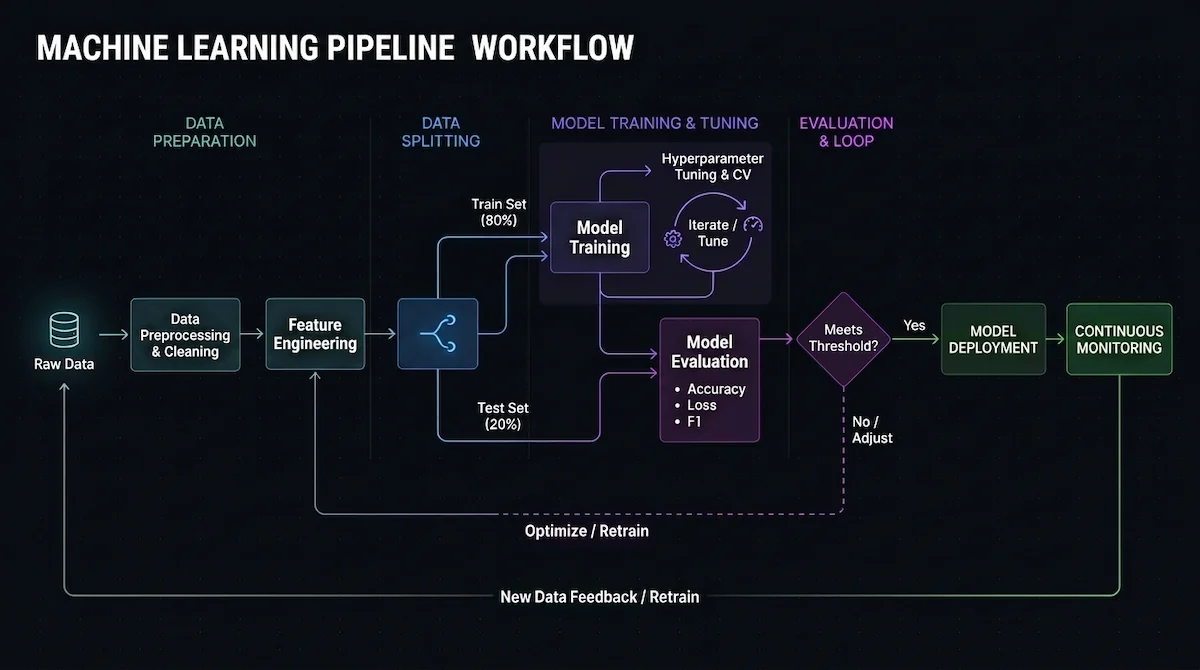
Creating a successful predictive system requires following a rigorous, step-by-step development lifecycle. Success is determined during the data preparation and feature engineering phases, long before you ever initialize or train a complex neural network.
Engineers begin by gathering, cleaning, and formatting raw data to resolve missing values and anomalies. Next, the dataset is split into training and testing subsets using libraries like Scikit-learn’s model selection tools to prevent overfitting.
based on the previous machine learning fundamentals, here is a foundational Python snippet demonstrating how to split raw data into training and testing arrays before modeling:
from sklearn.model_selection import train_test_split
import pandas as pd

# Load your dataset
data = pd.DataFrame({
    'feature_1': [10, 20, 30, 40, 50],
    'feature_2': [1, 2, 3, 4, 5],
    'target_label': [0, 1, 0, 1, 0]
})

X = data[['feature_1', 'feature_2']] # Features
y = data['target_label']             # Labels

# Split 80% for training, 20% for testing
X_train, X_test, y_train, y_test = train_test_split(X, y, test_size=0.2, random_state=42)
print(f"Training samples: {len(X_train)} | Testing samples: {len(X_test)}")
Concept 6: Managing Model Complexity
A key challenge in predictive programming is balancing bias and variance, which affects a model’s ability to adapt to various datasets. Achieving the right balance is crucial for creating a robust and generalizable model.
High bias can lead to underfitting, where the model is too simplistic to recognize patterns in the data. Conversely, high variance results in overfitting, where the model becomes too complex and memorizes the training data, struggling with new examples.
Utilizing regularization techniques, such as penalizing overly complex variables, can help maintain model generalizability. Effective systems are designed to find the optimal point where accuracy on training data aligns with real-world performance.
Concept 7: Artificial Neural Networks
As dataset size and complexity scale, traditional machine learning fundamentals can run into severe performance ceilings. This challenge led to the development of deep learning, a specialized subfield inspired by the structural patterns of human neural pathways.
Artificial neural networks pass input features through layers of interconnected mathematical nodes, automatically learning highly complex representations without requiring manual feature engineering. You can explore standard neural structures via the official PyTorch framework tutorials.
This automated feature discovery makes deep learning highly effective for complex tasks like image recognition, natural language processing, and generative AI generation. It is the computational foundation that powers the most advanced automation systems in the modern enterprise.