
Transitioning from sandbox pilots to live operations necessitates a complete rethinking of how software interacts with business logic when deploying AI agents in the enterprise. The true measure of success for an AI agent lies in its ability to complete transactions by interpreting inputs, checking databases, and updating records autonomously.
While sandbox success is valuable, it does not guarantee performance in live, highly regulated business environments. Implementing AI in production within an enterprise is approximately 90% an infrastructure and process design challenge, and only 10% an AI challenge. This guide provides the blueprint needed to deploy sovereign, transaction-capable agents that deliver consistent value.
Strategy 1: Isolate Interpretation from Decision Logic
AI models excel at reading messy, unstructured inputs like emails and PDFs. However, they are naturally unpredictable when trying to make complex policy decisions on the fly. If you allow a model to evaluate corporate policy without deterministic guardrails, you are inviting compliance and financial risk into your pipeline.
The correct architectural approach isolates the interpretation step from the decision-making step. Use the AI to extract and structure incoming data, then hand that data to a deterministic, rule-based Python function or enterprise API. This ensures every critical decision remains consistent, auditable, and fully compliant.
Below is a Python sample using the Pydantic validation library to force an AI agent to output strict, typed data before it ever hits your legacy business logic:
from pydantic import BaseModel
import json

# Define the strict schema the agent MUST return
class AgentExtraction(BaseModel):
    customer_id: str
    intent: str
    risk_score: float

# Validate the AI's raw JSON output before executing business logic
raw_ai_output = '{"customer_id": "C-9876", "intent": "refund", "risk_score": 0.15}'
parsed_data = AgentExtraction.model_validate_json(raw_ai_output)

if parsed_data.risk_score < 0.2:
    print(f"Safe to process {parsed_data.intent} for {parsed_data.customer_id}")
Strategy 2: Integrate Deeply with ERP Legacy Systems
Enterprise data rarely lives in modern, API-friendly databases. It is typically locked inside SAP, Oracle, Guidewire, or mainframe systems that require specialized handshake protocols. An agent that cannot work inside these legacy environments is essentially useless for high-value operational tasks.
Focus your engineering effort on building robust integration layers with these core transactional systems. Use secure middleware or reliable RPA toolkits to bridge the gap between AI orchestration and legacy APIs. This ensures agents can execute deep database writes like updating a customer ledger or submitting an inventory receipt safely.
Ensure these legacy connectors are resilient against system lag and timeout errors. If an SAP transaction stalls, your agent must handle it with robust error logic rather than failing silently. Mastering these custom connections is mandatory when deploying AI agents in the enterprise.
Strategy 3: Establish Multi-Tiered Governance
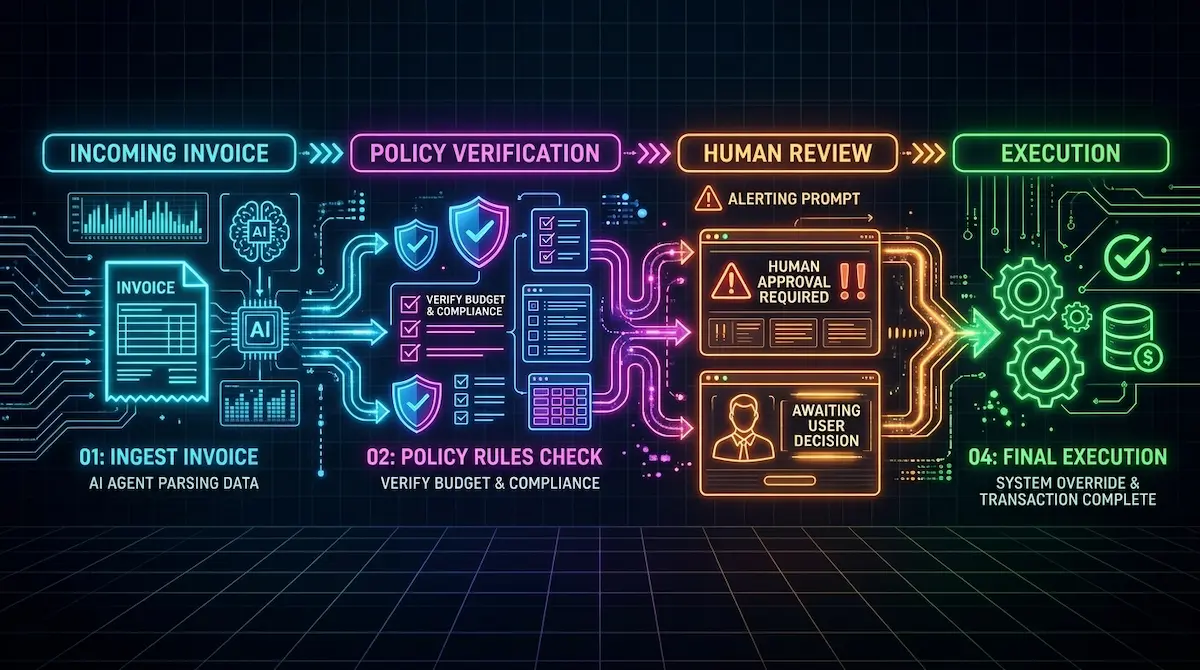
Deploying AI agents in the enterprise cannot run entirely unchecked from day one. You must implement a progressive, multi-tiered governance model that builds organizational trust while minimizing risk. This structured approach prevents catastrophic write-back errors.
Level 1 starts with assisted mode, where the agent gathers data and recommends an action for a human to execute. As confidence grows, transition to supervised execution (Level 2), where the agent executes the task and queues it for human approval. Level 3 permits autonomous within-policy execution, routing out-of-policy exceptions directly to a person.
This progressive rollout provides a clear path for validating performance and adjusting confidence thresholds. The human in the loop is not a bottleneck; they are a vital training and security resource. Progressive governance ensures your automation scales safely.
Strategy 4: Prioritize Sovereign Infrastructures
Enterprise deployments must comply with rigorous regulatory frameworks, such as GDPR, DORA, and the EU AI Act. Processing sensitive customer, financial, or operational data on third-party cloud systems is often a compliance showstopper for major institutions.
Prioritize hybrid, self-hosted, or fully on-premises deployment options when deploying AI agents in the enterprise. Implement Bring Your Own Key (BYOK) encryption to retain full control over your data. This ensures your systems meet all regional compliance requirements without sacrificing agent capability.
Building a sovereign deployment protects your intellectual property and future-proofs your AI systems against changing regulations. Security isn’t an afterthought; it is the foundation of every scalable enterprise deployment.
| Automation Level | Operational Behavior | Write-Back Action | Risk Mitigator |
|---|---|---|---|
| Level 1: Assisted | Assembles case, retrieves records | Human executes | 100% human review |
| Level 2: Supervised | Executes in-policy, queues outcome | Approve before save | Pre-write audit |
| Level 3: Autonomous | Resolves inside policy bounds | Automated write-back | Exception routing |
| Level 4: Managed | Handles tasks & missing proof | Automated write-back | Confidence gating |
Strategy 5: Run Parallel Production Tests
Simulated trials often overlook the complexities, edge cases, and variability present in a live enterprise environment. Before enabling automated database writes, it’s essential to confirm your agents against real-world workloads using historical shadow data.
Run the agent in tandem with your human teams on live cases, ensuring that write-back capabilities are disabled. Compare the agent’s results with the decisions made by experienced operators to assess accuracy. Adjust your confidence thresholds based on these parallel runs to enhance performance.
This parallel testing phase provides the necessary evidence to satisfy internal compliance, legal, and operational reviews. Demonstrating accuracy with actual data is crucial for building executive confidence. A successful trial will confirm that the agent is ready for production before it initiates any live updates.
Strategy 6: Prevent Unchecked Cost Sprawl
Enterprise automation is highly prone to expensive cost leaks. A single agent caught in an infinite retry loop or inundating API endpoints can generate thousands of dollars in unexpected bills over a single weekend.
Implement strict, per-department and per-agent budget caps directly within your orchestration layer. Set alerts to flag unusual usage and kill-switches to halt any workflow that exceeds daily spending thresholds. You can reference best practices in the OpenAI Production Best Practices guide for rate limiting.
Pre-emptive cost controls are essential for scaling automation safely across multiple business units. Managing cost at the agent level prevents budget overruns before they can derail your quarterly projections. Always secure your budget framework before scaling up.
Strategy 7: Deploy Comprehensive Observability
If an agent makes an error, it’s essential to trace the exact reason behind its action. A lack of observability can make AI a liability, particularly when deploying AI agents in enterprises where regulators require complete transaction traceability.
Implement audit logs that clearly outline every decision, database query, and model input in plain text. Check the entire execution path to detect performance lags and bottlenecks. This allows compliance teams to quickly verify that every automated transaction adheres to company policy.
Enhanced observability transforms your agents from a black box into a dependable business asset. When issues arise, your engineers can swiftly identify the problem, ensuring the automated workforce remains accountable and manageable.