For years, enterprise automation was characterized by rigid scripts that mimicked human actions. Today, the landscape has changed dramatically. By connecting legacy systems with modern machine learning, the combination of intelligent RPA and APIs is transforming how organizations scale their software deployment. This synergy enables businesses to transition from simple task execution to highly cognitive, autonomous workflows.
The Evolution: From Traditional Scripts to Intelligent RPA and APIs
Traditional Robotic Process Automation (RPA) was effective for repetitive, rules-based tasks such as data entry and invoice processing. However, it was often fragile; a single UI update could disrupt an entire workflow. The advent of cognitive technology has revolutionized this approach. With intelligent RPA and APIs, automation bots no longer depend solely on screen scraping. Instead, they securely interact with underlying databases and use AI models to “understand” the data they handle.
Intelligent RPA leverages optical character recognition (OCR), natural language processing (NLP), and machine learning to handle unstructured data. When integrated with advanced AI endpoints (like the OpenAI or Anthropic APIs), these bots can make dynamic decisions, categorize sentiment in emails, and handle edge cases that would normally require human intervention.
How Intelligent RPA and APIs Work Together in Production
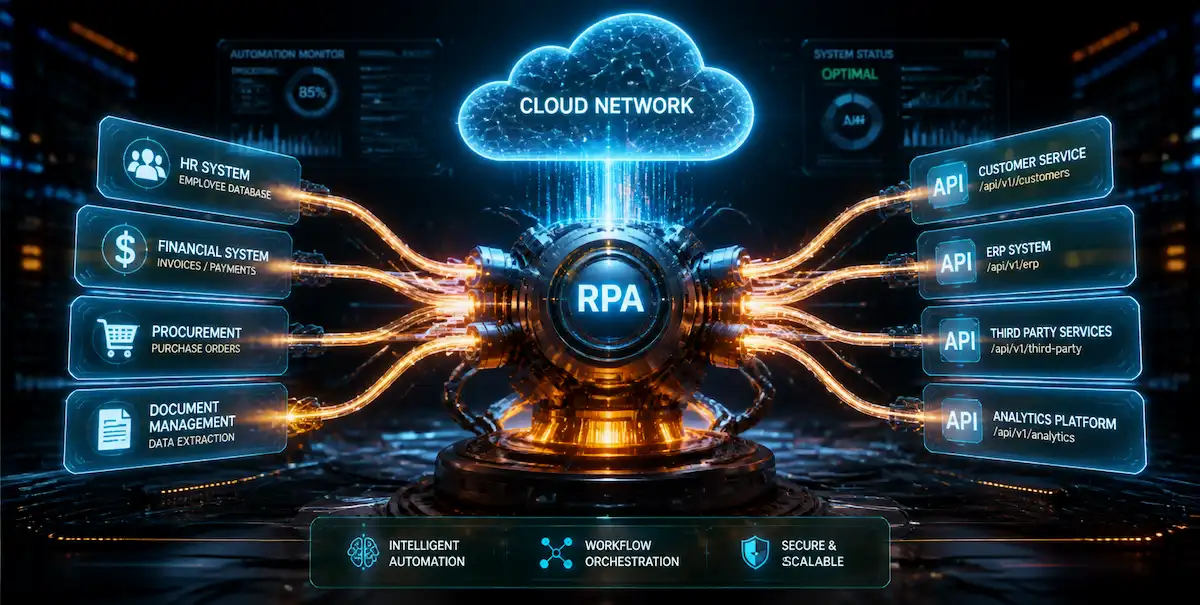
In a production environment, achieving flawless automation requires a hybrid approach. The architecture of intelligent RPA and APIs relies on letting each technology do what it does best. APIs handle the secure, lightning-fast data transfer between cloud applications, while the RPA bot acts as the orchestrator, reaching into legacy on-premise systems that lack native API support.

5 Core Architectural Benefits of this Integration
- Unbreakable Resilience: APIs do not break when a software’s graphical user interface (GUI) changes, making the overall pipeline significantly more robust.
- Cognitive Processing: By pinging AI models via REST APIs, the RPA bot can summarize documents or generate personalized client responses on the fly.
- Enterprise-Grade Security: Direct API connections utilize OAuth2 and encrypted tokens, which is far more secure than storing user credentials for screen-scraping bots.
- Lower Latency: API data transfers occur in milliseconds, drastically reducing the execution time of multi-step automation sequences.
- Scalability: Cloud-based API workflows can scale instantly during high-demand periods without requiring additional virtual machines for RPA bots.
Code Example: Orchestrating an AI API within an RPA Pipeline
To illustrate how intelligent RPA and APIs function together, consider an automation script designed to process incoming vendor contracts. The RPA bot retrieves the PDF, extracts the raw text, and then pushes that text to an AI API for structured analysis.
import requests
import json

def analyze_contract_via_api(raw_text):
    url = "https://api.openai.com/v1/chat/completions"
    headers = {
        "Authorization": "Bearer YOUR_API_KEY",
        "Content-Type": "application/json"
    }

    payload = {
        "model": "gpt-4-turbo",
        "messages": [
            {"role": "system", "content": "Extract the vendor name and total cost as JSON."},
            {"role": "user", "content": raw_text}
        ],
        "response_format": { "type": "json_object" }
    }

    response = requests.post(url, headers=headers, json=payload)
    return response.json()
This code snippet represents the exact moment an RPA workflow becomes “intelligent.” Instead of trying to parse a complex legal document using rigid regex rules, the bot relies on a highly trained AI model to return perfectly structured JSON data, which the RPA bot then inputs directly into the company’s ERP system.
Optimizing Costs in Intelligent RPA and APIs
Scaling these workflows across an enterprise introduces a new challenge: computational cost. Because intelligent RPA and APIs rely heavily on large language models (LLMs), token usage can skyrocket if the bots are feeding unoptimized, bloated text into the API endpoints.
To maintain profitability, developers must implement strict token optimization frameworks. This involves preprocessing data (removing HTML tags, white space, and irrelevant boilerplate) before the RPA bot makes the API call. Efficient payload structuring ensures the enterprise gets the cognitive benefits of AI without the exorbitant API billing.
Future-Proofing Enterprise Automation
The future of enterprise software is agentic. As AI models continue to improve in speed and reliability, the dependence on rigid automation will diminish. Understanding the framework of intelligent RPA and APIs is the essential first step for organizations aiming to develop fully autonomous AI agents that can reason, plan, and execute complex business objectives.