
The recent rollout of Google AI Max upgrades has fundamentally transformed how digital marketers manage automated advertising ecosystems. These new features eliminate the traditional black box of algorithmic bidding by providing unprecedented visibility into campaign performance metrics. Advertisers now possess the exact tools necessary to steer artificial intelligence using custom natural language prompts and detailed demographic signals.
Historically, relying on machine learning for ad placement meant sacrificing transparency at the enterprise level. Marketing teams struggled to connect specific search queries to the actual creative assets displayed to the user. This lack of granular data made optimizing return on ad spend incredibly difficult for agencies managing massive daily budgets.
By implementing these new reporting structures, businesses can finally map the entire customer journey from the initial search to the final landing page. This technical guide breaks down the precise methodologies required to implement these platform changes and regain absolute control over your digital marketing campaigns.
| Campaign Architecture | Creative Control | Reporting Transparency | Setup Complexity |
|---|---|---|---|
| Legacy Standard Search | Manual (A/B Testing) | High (Keyword Level) | High (Manual Bids) |
| Initial AI Max Bidding | Automated (Black Box) | Low (Aggregated) | Low (Set & Forget) |
| Updated AI Max | Prompt-Driven (AI Brief) | Maximum (Unified View) | Medium (Strategic) |
1. Understanding the New AI Brief Functionality
The most significant feature introduced in these updates is the expanded AI Brief capability. This system acts as a direct steering mechanism for the underlying automation algorithms, allowing marketers to feed the system precise natural language commands. Instead of simply providing a target cost-per-acquisition (CPA) and a URL, advertisers define their core messaging directly.
This closed beta feature has now officially expanded into seven additional languages: Dutch, French, German, Italian, Japanese, Portuguese, and Spanish. This global rollout enables multinational corporations to deploy highly customized, localized campaigns without relying entirely on generic machine translation models. It ensures that the generated ad copy resonates culturally with the specific regional target audience.
To maximize the effectiveness of the AI Brief, marketers must treat the configuration phase similar to prompt engineering for large language models. Providing the system with rich, context-heavy descriptions of the ideal customer profile yields significantly higher conversion rates than using broad, generic targeting parameters.
2. Implementing Unified Reporting Dashboards
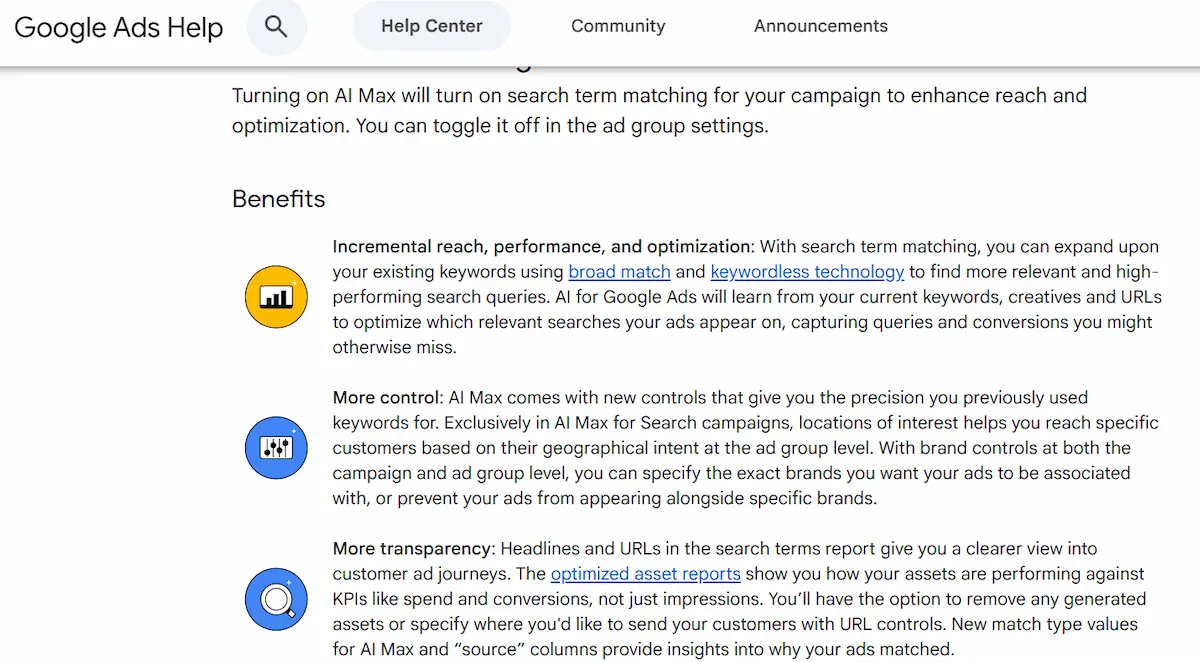
Alongside the language expansion, the platform has completely overhauled its backend data visualization structure. The new unified reporting interface solves the industry’s biggest complaint by linking three critical data points into a single, cohesive dashboard. Advertisers can finally see the exact search term used, the specific creative asset shown, and the final landing page destination simultaneously.
This transparency represents a massive victory for conversion rate optimization (CRO) specialists globally. By revealing the exact journey from query to conversion, marketers identify exactly which AI-generated asset combinations are driving actual revenue. This eliminates the guesswork previously required when auditing automated campaign performance for enterprise clients.
Agencies utilizing Google AI Max upgrades can export this unified data directly into third-party visualization tools via native API connections. Integrating this granular reporting into Looker Studio or Tableau provides executive teams with a clear, indisputable view of how artificial intelligence allocates their advertising budget.
3. Automating Data Extraction with Scripts
Relying solely on the native user interface is highly inefficient for large-scale enterprise media operations. Advanced media buyers utilize custom JavaScript snippets to extract this new unified reporting data automatically via the platform’s developer API. This programmatic approach allows technical teams to monitor performance anomalies in real-time without manual dashboard refreshing.
Below is a foundational JavaScript payload designed to query the newly exposed asset performance metrics directly from the backend. By deploying this script within your account, you automatically log high-performing creative combinations into an external database for further statistical analysis.
function main() {
  const query = `
    SELECT
      campaign.name,
      metrics.clicks,
      metrics.conversions,
      asset.name
    FROM asset_performance_report
    WHERE metrics.clicks > 100`;
  const report = AdsApp.report(query);
  report.exportToSheet(SpreadsheetApp.getActiveSpreadsheet().getActiveSheet());
}Running this automation daily ensures that your marketing team immediately identifies which AI-generated headlines resonate strongly with users. It provides the raw datasets necessary to pause underperforming creative assets before they consume a significant portion of your daily budget allocations.
4. How Google AI Max Upgrades Impact Account Strategy
The introduction of these advanced Google AI Max upgrades features forces agencies to fundamentally rethink their entire account architecture. Consolidating smaller, fragmented campaigns into a single, highly optimized AI-driven entity is now the recommended best practice across the industry. The machine learning model requires massive amounts of historical data to train its predictive algorithms effectively.
By feeding all available conversion data into a unified campaign structure, the system identifies subtle purchasing patterns that human analysts frequently miss. However, this consolidation strategy only works if the initial AI Brief is configured with absolute precision. Loose targeting parameters quickly result in rapid, uncontrollable budget exhaustion.
Furthermore, marketers must actively manage their negative keyword lists and brand exclusion settings on a weekly basis. While the automation algorithms are incredibly powerful, setting strict negative boundaries prevents the system from bidding on irrelevant search terms or displaying ads on low-quality publisher networks.
5. Securing High-Intent Conversions and Workflows
Another helpful Google AI Max upgrades is related to capturing high-intent traffic which requires seamless alignment between the ad creative and the final landing page experience. The updated reporting tools allow marketers to verify that the AI routes specific audience segments to the most relevant destination URLs. Mismatched landing pages remain the primary cause of inflated bounce rates in automated campaigns.
Download the complete automated reporting dashboard template and JavaScript tracking codes in our in our free Insider Hub.
To prevent this disconnect, advertisers must leverage dynamic URL insertion and robust tracking templates across their entire account. Ensuring that URL parameters correctly pass the campaign data to your backend CRM allows sales teams to attribute revenue directly to specific AI-generated ad variations effortlessly.
Additionally, integrating these Google AI Max upgrades with external automation platforms like Make.com unlocks powerful post-click workflows. When a user submits a lead form on the landing page, the data routes instantly to Slack or Salesforce, triggering an immediate and highly personalized follow-up sequence.
6. Optimizing Creative Assets for the New Algorithm
The expanded reporting visibility demands a rigorous approach to creative asset generation. Because marketers can now track exactly which image and text combinations drive conversions, uploading generic placeholder graphics is a massive operational mistake. The algorithm heavily favors accounts that provide a diverse matrix of high-resolution visual assets.
To capitalize on this, design teams must utilize generative AI tools to rapidly produce localized variations of their core advertising collateral. Providing the system with multiple aspect ratios and tailored emotional hooks allows the machine learning model to assemble the perfect advertisement for each specific user demographic instantly.
Executing this creative matrix effectively requires a seamless partnership between the creative department and the technical media buyers. When compelling visual design feeds directly into a highly optimized, transparent delivery algorithm, enterprises achieve unprecedented scale and efficiency across their entire digital footprint.
7. Preparing for Future Advertising Automation
As artificial intelligence continues to dominate the digital advertising landscape, manual bidding strategies are becoming entirely obsolete. The agencies that master these new capabilities secure a massive competitive advantage in the marketplace. Early adoption of these transparent reporting tools allows marketing teams to scale their client accounts with unprecedented confidence.
The era of the black box algorithm is officially ending for major ad networks. By providing marketers with granular data visibility and natural language steering controls, the platform establishes a new technical standard for automated media buying. The focus shifts permanently from manual bid adjustments to high-level strategic orchestration.
Achieving success in this new ecosystem requires a highly disciplined hybrid approach. Marketers must trust the machine learning algorithms to execute the micro-bidding decisions while firmly maintaining absolute control over the macro-level business strategy, creative direction, and brand safety parameters.
Explore More on The NexGen AI
- Latest Updates: Browse our latest coverage on artificial intelligence breakthroughs
- Automation Guides: Claude Computer Use: 5 Powerful and Shocking Automation Features
External Resources for Google AI Max Upgrades
- Search Engine Land: Official AI Brief and Reporting Announcements
- Google Ads Developers: Google Ads API Documentation
- Make.com: Automating Google Ads Lead Forms